 Post
Post  Share
Share  Email
Email  Copy link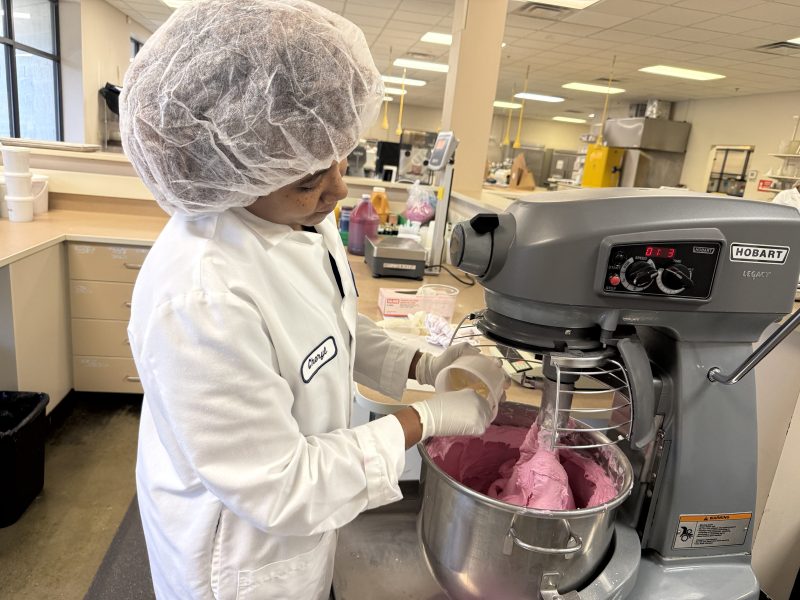
TUCKER, Ga. — Food scientists move between workstations with the smell of roasted sugar and hum of ovens serving as a background on a recent fall day at the nondescript facility located in an Atlanta suburb.
The smell of pistachio muffins and red velvet cakes fill the air as a technician slowly mixes buttercream frosting. Wearing a white lab coat, she adds an off-white buttercream into the mixer and then a base color.
Slowly, she stirs buttercream and puts additional ingredients into the mixer and with smooth methodical motions, pillowy mounds of bright pink frosting quickly form.
It’s all part of the Rise Baking Company’s work to remove all certified synthetic colors from its products by the end of next year – without sacrificing the brand’s well-known taste and quality.
The scene at the research and development facility depicts the crafting and testing of buttercream icings made by the R&D team with colors from natural sources. The wholesale manufacturer of bakery goods has a dedicated team of food scientists working to meet the company’s goals.
“We are conducting rigorous testing and taking a quality-first approach to bringing solutions to the market,” Rise Senior Director of Product Marketing and Strategy Naomi Moore said.
The project was under way when Platinum Equity partnered with Butterfly, a private equity firm specializing in the food sector, to acquire Rise Baking Company in November 2024. Established in 2013, Rise Baking Company supplies bakery products to in-store bakeries and food service customers. The company currently operates 20 facilities across North America with more than 3,000 employees.
Platinum Equity has extensive experience in the food and beverage sector. Its portfolio currently includes Horizon Organic (organic milk), Fantini Group (wine distributor), and Iberconsa (frozen seafood).
“We view Rise as an established leader with impressive scale and a strong foundation with a lot more room to grow both organically and through additional M&A,” Platinum Equity Co-President Jacob Kotzubei said in the news release announcing the acquisition. “Beyond the quality of its products, we believe the quality of Rise’s people helps set it apart. The team’s creative spirit, deep understanding of market trends, and hands-on, in-store expertise provide its customers tremendous value. We look forward to deploying our financial and operational resources to help the company expand its reach.”
That creative spirit was on full display during the recent demonstration at the R&D facility roughly 30 miles north of downtown Atlanta where Moore and a dedicated R&D team work on the project.
“Colors from natural sources come with a completely different set of challenges,” Director of R&D Sarah Key said. “It’s not as straightforward as adding a color and calling it done. These new ingredients interact with formulas in their own ways and have different handling requirements compared to certified synthetic colors, so we’ve been doing extensive testing and planning to make sure our products meet the same high standards our customers expect.”
The initiative started when the U.S. Food and Drug Administration banned the use of Red 3 in foods and oral medications (effective by January 2028). Ahead of government regulations, Rise Baking Company decided it would be more effective to remove all synthetic coloring in more than 400 products, which includes cakes, icings, muffins, cookies and pies.
“We are proactively pursuing these changes in response to growing consumer interest in simpler ingredients,” Moore said. “We are prepared to support our customers as they transition to products that meet shifting consumer expectations and comply with federal and state-level regulations on certified synthetic colors.”
A taste test shows how it works
To show how it works, a technician produced four blue frostings for taste testing. Each had the same vibrant color but with different flavor profiles. Accounting for the control batch, there was general agreement among the taste testers that there were differences in each and agreement on the preferred solution.
Once satisfied with the taste, which can take multiple tests, the team sends a sample to customers for approval.
Synthetic colors are created in a lab, which makes for a simple process, but because natural colors vary in the base flavor profile, the team has to test each color. Natural colors are mostly derived from botanicals, which are plants or plant parts (leaves, flowers) that are valued for their medicinal or therapeutic properties, flavors, scents – or colors.
“Botanicals have a flavor to them,” Key said. “For example, paprika has color that is extracted from it, but it also has a flavor to it. The color hasn’t changed our icing consistency, but it has made it a challenge to deliver the flavor of icing to what everyone is expecting.”
Rise Baking Company adds flavorings such as vanilla to deliver a preferred flavor since every plant, fruit and vegetable is different. And while natural colors still deliver beautiful results, factors like sourcing, weather, supply chain and harvesting create challenges.
Rise Baking Company Senior Director of Procurement Angela Saxton said: “Synthetic and natural color supply chains operate very differently. Our sourcing strategies center on collaborating with suppliers to fully understand these dynamics and mitigate supply risk.”
“Black carrot, for example, can be grown in both Asia and North America. If a crop in one region is hit by a disruption, we have alternative availability in another geographical region.”
Rise Baking Company also has standards and regulations for the products used by color suppliers.
“Some suppliers use their own seeds, but the land, water quality, soil nutrients as well as other factors can all influence what we can get out of the botanicals,” Key said.
Rise Baking Company ensures flavor, color and performance of each product is just right before they go to market.
“Our customers are our No. 1 focus, and we will be ready to meet their needs as they navigate consumer demands and the evolving regulatory environment,” Moore said.

 Email Dan
  +1 310.282.9202
  Post
Post  In
In  Email
Email  Copy link