 Post
Post  Share
Share  Email
Email  Copy link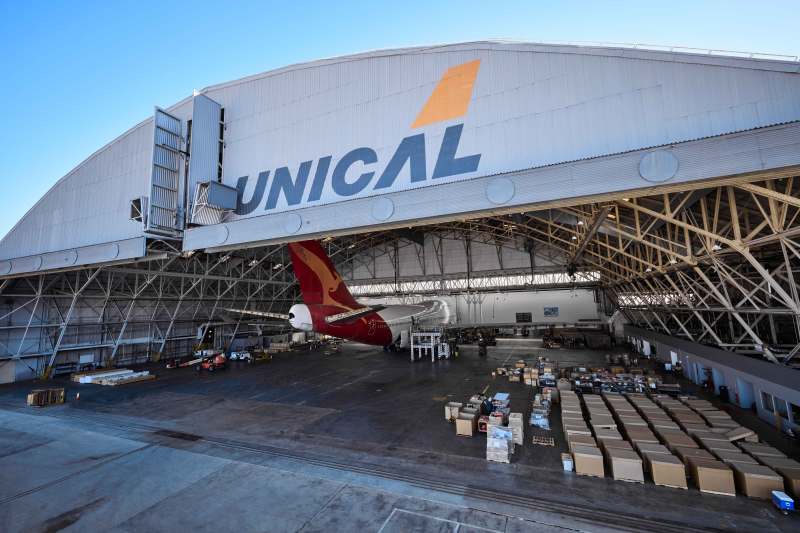
BEVERLY HILLS, Calif. – Platinum Equity’s divestiture of Unical Aviation underscores the firm’s operational value-creation strategy in the aerospace sector.
Prior to the 2021 acquisition, the aircraft-parts supplier was an under-managed, family-owned business in need of professionalization. Its warehouses were stacked with wooden crates stacked 40 feet high. Millions of aircraft parts sat in inventory, some difficult to locate and even harder to value. The company’s financial data was disorganized, its management bench was thin and the basic economics of buying aging aircraft, tearing them down and selling the parts required months of diligence to fully understand.
The company also faced major headwinds – which included an industry downturn because of COVID. The situation spooked competitors, according to firm leadership.
That uncertainty created opportunity.
Four years later, after some challenges, that complicated business has been transformed into a data-driven aftermarket aerospace company with a standalone business model that has shifted focus from legacy parts distribution toward the higher-margin used serviceable material (USM) market.
“It was quite a four-year journey during the underwriting process, very comprehensive value creation plan developed, including identifying talent that we needed to recruit, systems and processes we needed to put into the business, but it was not all smooth sailing,” Platinum Equity Co-President Jacob Kotzubei said during the firm’s latest Club Room Conversation for employees at Beverly Hills headquarters in early August.
Highlights of Unical’s transformation under Platinum Equity include:
- Building a new leadership team of seasoned aerospace aftermarket professionals.
- Modernizing technology platforms, including new ERP, auto-quoting and e-commerce systems, better enabling Unical to scale.
- Optimizing geographic footprint and relocated headquarters from California to Arizona and MRO operations to a purpose-built, lower-cost facility.
- Diversifying inventory to include narrowbody and next-generation aircraft and engine content.
- Establishing a dedicated asset management team focused on maximizing returns.
- Completing strategic add-on acquisition ecube, which enhanced Unical’s end-of-life services and its global footprint.
Satair is better able to capture the full value of an aircraft’s lifecycle, lower airline maintenance costs, and mitigate manufacturing bottlenecks to build resilient supply chains.
The acquisition included Unical’s and ecube’s seven operational sites and offices across North America, Spain, and the United Kingdom, with the company reporting a combined 2024 revenue of $298 million and headcount of more than 400. The divestiture to Satair earlier this year is part of the recent momentum generated by Platinum Equity’s Small Cap team.
“Unical took a read deep dive from the Platinum Ops team,” said Managing Director Dan Krasner, the M&A Deal Lead. “How do we do this more efficiently? What is broken here? What’s working? What’s not working? That is the work that our Ops team supports. It’s in the details that you really make the businesses better, and there was a lot of opportunity here. We could see that strategically the right elements were there, but the execution (needed improving).
“That’s where our Ops team was really able to help management right the ship.”
Unical’s Transformation
The first challenge was figuring out what Platinum Equity actually was acquiring.
Unical’s sprawling inventory contained millions of aircraft parts, but the company had limited visibility into what was valuable, what could be sold and what should never have been harvested from an aircraft. Its sales team had years of quote and win-loss data at its disposal but largely relied on instinct rather than using that information to guide purchasing and inventory decisions.
“The business was built around buying end-of-life aircraft, tearing down the aircraft for parts to resell back into the aviation market. It made it very difficult to understand financially,” Managing Director Dan Frich said of the diligence process. “You’re buying an aircraft for one price and then you’re trying to figure out how to allocate costs across thousands of different parts that you might be able to sell. We were able to really dig in, go deep in the data and really get a much more representative picture of the profitability and potential of the business.”
Once the transaction closed, the firm began rebuilding Unical’s management team and developing a more disciplined approach to inventory. The company looked at which parts generated the most value, what should be harvested from aircraft and what could be outsourced. The company also began using its sales data to make better decisions about what to buy and sell.
Then came the move.
Unical relocated roughly 600,000 to 700,000 square feet of inventory and an estimated 95 million parts from California to Arizona. The move was intended to lower costs and create a better long-term operating environment, but it exposed weaknesses.
Sales fell sharply. The company was clearly not going to reach EBITDA projections. Inventory was scattered across the Arizona operation, computer systems had been compromised, and internet connectivity was so poor that employees struggled to process orders. Vendors weren’t being paid and cash was running short.
The “light touch” investment had become a complete turnaround.
“Unical wasn’t paying vendors, they were running out of cash, and they had to get the fundamentals of the business back in order — fixing the systems, cleaning up the data and rebuilding the management team,” Managing Director Ali Bajwa said. “Once they knew what they actually had, they cut the repair cycle time down 40-50% and started getting cash back into the business, they could pay vendors, buy more parts and get the operation moving again.”
‘This Is What Good Looks Like’
The recovery also created an opportunity to put Unical’s data to work.
The company eventually introduced automated quoting that drew on its market and historical sales data. According to Bajwa, Unical had been responding manually to about 9,000 of roughly 120,000 monthly quote requests. The new system doubled the number it could respond to and generated roughly $2.5 million a month in revenue without direct human intervention.
With the core operation stabilized, Platinum Equity made a much bigger strategic bet.
The firm spent roughly $80 million to $90 million on a large package of Airbus NEO aircraft entering the teardown market. The move gave Unical an early position in a newer aircraft type and, importantly, expertise that would later attract Airbus.
Firm leadership credits Senior VP Brett Reinhart, who is on the M&A Execution team and reports to Krasner, for doing the hard work necessary to learn the business.
“I went to trade shows and met with as many industry experts and competitors as I could to understand what was happening in the market and, more importantly, what good looked like,” Reinhart said. “I started piecing together what the margin profile, aircraft acquisition and sales processes should look like.”
Bajwa also said colleagues Chasen Ford and Aclan Sukaya were instrumental in the strategic exit that validated Platinum Equity’s original willingness to tackle a business others couldn’t understand — and turned a disorganized collection of aircraft parts into an aerospace aftermarket platform.
“Sometimes the best laid plans go awry, but it’s also a great example of how Platinum and our deep bench of operational talent can pivot as challenges arise in real time and course correct and fix things,” Kotzubei said. “It is really just a great example of all we are capable of.”

 Email Dan
  +1 310.282.9202
  Post
Post  In
In  Email
Email  Copy link